There is a short add on to this blog on the main page.
One of the " dreams" would be to be able to differentiate between O2 used and taken or reloaded to Mb and Hb. As mentioned in the Blog , we can't do that ( yet ). So any change in SmO2 will keep the question open from where we may the O2 .
: Where is it coming from?.
Physiologically we have some possible answers.
O2 from Mb is designed to help in " emergency" situation. meaning, in situation, where we have a reduced delivery over the blood.
There are 2 situations, where we have this.
1. At the start of a movement or activity out of a "cold" start . :
HR ( cardiac output) as well as respiration, as 2 of the main delivery systems are not yet fully at performance load. As well at the end of a survival situation to try to hang on, when vital organs are pushed to their own limit and ECGM ( or CG ) will try to help you to survive. So as the delivery to the extremity muscles are getting very low or even stops, due to maintenance of ATP levels in the more important organs, we will dig into any O2 we may still have locally. If we get there super low we have the picture of Rhabdomyolosis as a sign of complete overload and depletion of energy source of the muscles with destruction of the muscles itself in extreme cases.
So when you look at the total O2 diss curve you can see this situation, where and when affinity of O2 is better to be released from Mb.
As in the blood nicely written. ( see in red below )
However, the location of the molecules along the diffusion pathmust also be considered.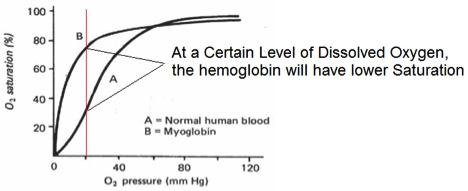
(photo)
Myoglobin is generally much closer to the mitochondria than the hemoglobin is, as it is found inside the muscle cell, whereas hemoglobin is found inside the red blood cell (See the sketch below. The O2 symbols represent the level of dissolved oxygen).
My add on . O2 loaded on Mb is much closer to the site, where it can be used, than O2 loaded on Hb. so in stress situations, where energy is immediately needed the body will take the closest energy available , which is the O2 on Mb. As at the rest or start situation the O2 diss curve of Mb is more right than Hb it is not just closer, but even easier to get.

Oxygen from the hemoglobin has to diffuse out of the red blood cell, through the plasma, capillary wall, interstitial fluid, and into the muscle cell. O2 from the Mb is sitting just there with less affinity at the start When there is a high rate of oxygen diffusion, the level of dissolved oxygen could be much lower around the myoglobin. This means that it is uncertain whether the hemoglobin or myoglobin is deoxygenating first. It might be helpful to know the hemoglobin and myoglobin oxygenation states separately, but the current state of the technology situationquo;t allow that.
So what we did we created a wheretio, hwere we would keep delivery CO and actually; up but stop to muscles use the O2 from working Thanels . load musclesgain the working beyond.
So basically we would keep a delivery above and theong what its needed in wormusclesng thecel but as well use high2 from respiratoryac and activitytory a thanity, musclesbsp; start again activityad and reduce respiratory and cardiac whenvityu to see, whether maintainsp; notnaitain delivery we would drop see a d the in SmO2 due to need local taking O2 from the storagetsroage ) Mb and musclesp; still loaded in active thecel.
The result where great no change in SmO2 level despite a severe change in load and unload form the muscular side.
Will show some of studtheuied in commingt few weeks. as I have some people theming over holiday to repeat seeh task independent form me to se,w theyher the can replicate resultsp; resutl.




